Google Merchant Center Image Requirements Changed: Audit Now
Google changed two Merchant Center image rules in October 2026. Low-quality flags no longer block products. The 500×500px deadline is January 31, 2027.
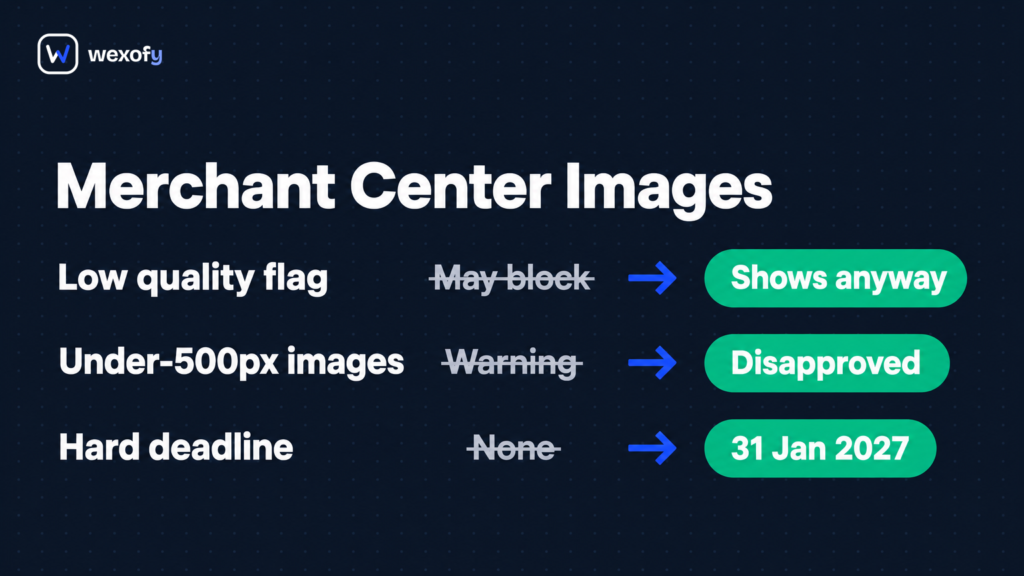
Google quietly changed its Merchant Center image requirements on October 12, 2026, and the update is easy to miss. Low-quality product images no longer block your listings from running, but a separate hard size rule arrives on January 31, 2027, and it will disapprove products across every Google surface at once. WooCommerce stores connected to Google Shopping need to know which of these rules still has teeth.
How Google Merchant Center Image Requirements Changed
Two things happened this week, and they are completely separate.
The old text on Google’s low image quality help page said that products with blurry, pixelated, or low-resolution images “may be prevented from showing in ads and free listings until the image quality improves.” As of October 12–13, that language is gone. The page now reads: “Your product will continue to show in ads and free listings.” The flag still appears in your account, but it is now a performance recommendation rather than an eligibility block. Google adds that “high image quality correlates strongly with user engagement and clicks.” PPC Land reported the rewrite on October 13, and Relevant Audience confirmed it independently.
The 500×500px minimum size requirement is a different rule and has not changed. Starting January 31, 2027, any product with an image in the image_link attribute smaller than 500×500 pixels will be disapproved. According to PPC Land, disapproval removes the product from Shopping ads, free listings, AI Mode, Gemini shopping experiences, and Google Lens virtual try-on simultaneously. Google began issuing warnings for undersized images in July 2026, and the requirement was formally published on April 14, 2026.
Google notes that some undersized images may be automatically optimised without merchant action, but has not specified which images qualify.
What This Means for a WooCommerce Store
If your store has products flagged for low quality but their images are at or above 500px, those products are still serving. Fix the images when you can. Google says better images drive more engagement, but this is no longer urgent. Work through them during your normal product photography cycle.
If your store has products with images under 500×500px, you have until January 31, 2027. After that date, those products disappear from every Google surface at once: the Shopping tab, AI Mode, Gemini shopping, and Google Lens all pull from the same feed.
WooCommerce does not enforce any minimum image size at upload. A store owner can add a 200×200px photo to a product today and the site will accept it without complaint. If that product is in your Google feed, whether through WooCommerce’s built-in data or a third-party feed plugin, it will be flagged now and disapproved in January. This is especially common in stores that:
- import product data from supplier feeds with older or compressed images
- carry legacy SKUs photographed before higher-resolution became standard
- use cropped thumbnails rather than full-size images in their feed configuration
That third point is the one most stores miss. Some feed plugins send a WooCommerce thumbnail, often the shop_thumbnail or woocommerce_thumbnail image size, rather than the full uploaded image. Depending on your theme’s image settings, that thumbnail may be cropped below 500px even if the original upload was larger. Check what your feed plugin actually sends, not just what you uploaded.
Google recommends images of 1,500×1,500px or larger for best performance across all listing formats. The 500px minimum is a floor, not a target.
What to Do Before January 31, 2027
- Open Merchant Center, go to Products, then Diagnostics. Filter for “Low image quality” and “Image too small” issues and download the affected product list from each.
- Sort by traffic or revenue. Fix your highest-impression products first. A disapproved bestseller costs more than a disapproved slow-mover.
- Replace all images below 500×500px. These are the only ones that will cause disapproval in January. Use the downloaded list as your checklist. Aim for 1,500×1,500px on replacements so you do not need to revisit this.
- Check your feed plugin configuration. In WooCommerce, go to Settings, then Products, then Images, and confirm the image sizes. If you use a Google feed plugin, open its settings and verify which image attribute maps to image_link. It should point to the full-size image, not a thumbnail.
- Move quality-only flagged images to a later pass. Products flagged as blurry or pixelated but above 500px are still serving. Add them to your next product photography batch.
- Request a re-crawl after uploading replacements. In Merchant Center, go to the affected products and use “Request review,” or wait for the next scheduled crawl. Google does not re-evaluate images automatically the moment you update them.
The Rules That Did Not Change
The October update applies to the blurry and pixelated quality flag only. Products are still disapproved for promotional overlays: images that include text such as “Buy Now,” a price, a discount percentage, “Free Shipping,” or any other offer language. That policy was not touched.
The prohibition on watermarks, borders, placeholder images, and images that are not of the actual product has not changed. If your images were already disapproved for one of those reasons, the October update does not affect that.
We also covered a related Merchant Center issue last week: products being disapproved because their price changes more than once per day. If you are running a Diagnostics audit this week, check for price and availability issues at the same time.
Sources
- Google Merchant Center Help: How to fix low image quality
- PPC Land: Google stops blocking low-quality product images from ads and free listings
- PPC Land: Google blocks product images under 500×500 pixels from 31 January 2027
- Relevant Audience: Merchant Center low image quality no longer blocks products