2026 Holiday Shipping Surcharges: Update Your Rates Before October 25
UPS and FedEx residential demand surcharges activate October 25. Here are the carrier amounts for 2026 and the WooCommerce settings to review before the deadline.
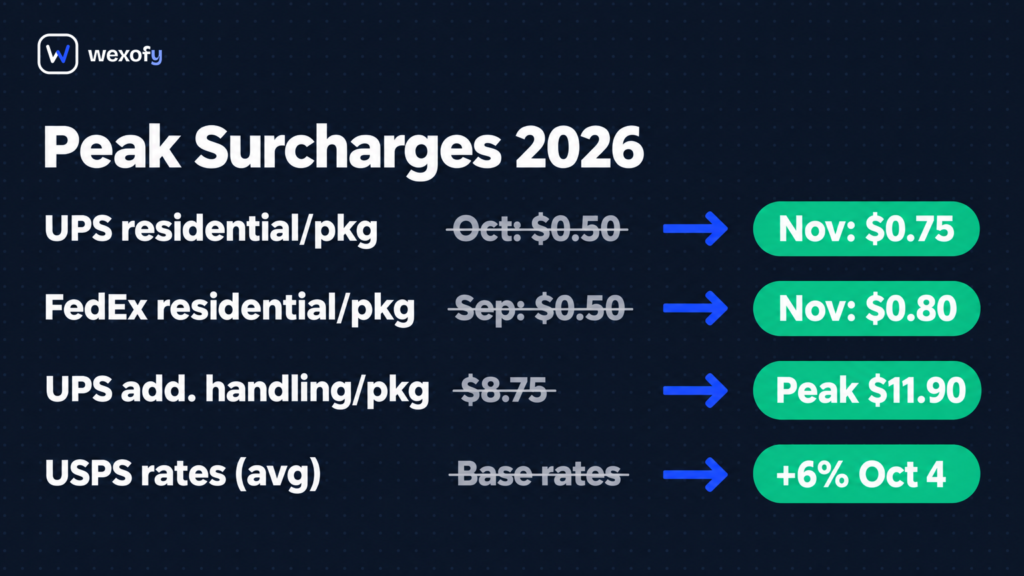
USPS has already been charging more since October 4. UPS activates its residential demand surcharge on October 25, ten days from now, and DHL eCommerce joins the same day. For any WooCommerce store shipping physical goods to US residential addresses, the 2026 holiday shipping surcharges are either already live or arriving within the week, and the steepest charges land exactly during Black Friday and Cyber Monday. If your flat rates or free-shipping threshold were last reviewed before this season, you have a narrow window to adjust them.
What the 2026 Holiday Shipping Surcharges Cost Per Package
All four major US carriers are running demand surcharges simultaneously this peak season. The numbers below come from the carrier schedule data compiled by Ordoro and Pipe17.
UPS (September 27, 2026 – January 16, 2027):
- Residential demand (Ground Residential, Ground Saver): $0.50 per package from October 25 to November 21, rising to $0.75 per package from November 22 through December 26, then back to $0.50 from December 27 to January 16.
- Additional Handling: $8.75 per package until November 21, then $11.90 per package at peak.
- Large Package: up to $117.50 per package during peak.
- Air services: $2.50 per package during peak.
FedEx (September 28, 2026 – January 17, 2027):
- Residential / Home Delivery demand: $0.50 per package from late September, rising to $0.80 per package from November 23 through December 27.
- Additional Handling: $8.80 per package pre-peak, up to $11.85 per package during peak.
- Ground Economy: $2.55 per package pre-peak, up to $4.05 per package at peak.
- Oversize: up to $117.25 per package during peak.
USPS (October 4, 2026 – January 17, 2027): Temporary price adjustments averaging approximately 6 percent across Priority Mail Express, Priority Mail, Ground Advantage, and Parcel Select, already in effect. Ground Advantage increases range from $0.40 on light packages in nearby zones to $7.70 on heavier items in distant zones.
DHL eCommerce (October 25 – January 16, 2027): $0.50 per package, rising to $0.90 during the core peak window (November 22 – December 26).
One more date to note: FedEx announced a permanent average rate increase of 5.9 percent effective January 4, 2027. The peak surcharge period and the new permanent base rates overlap for two weeks, from January 4 through January 17.
What This Means for Your WooCommerce Store
Live-rate stores (those pulling real-time quotes from a carrier API or shipping platform) should receive updated rates automatically. That said, some WooCommerce shipping plugins cache rate tables locally, and a cache that has not refreshed since before the surcharge schedules were published will serve stale quotes. Verify that your plugin is not working from an outdated snapshot.
Flat-rate stores carry the full exposure. A $7 flat rate set earlier this year will undercharge for a residential UPS Ground shipment to a distant zone once the October 25 surcharge activates. By late November, you will be absorbing both the $0.75 demand surcharge and any additional-handling charge on oversized packages, with none of that passed on to the customer.
Stores with a free-shipping threshold: the surcharges shrink your margin on every qualifying residential order starting October 25. The dollar amounts look modest per package, but across a Black Friday or Cyber Monday volume spike, they add up. Check the math before you finalize a promotional discount; our post on checkout details that cost WooCommerce stores conversions covers how threshold positioning affects buyer behavior if you want to think through the broader tradeoff.
The charge that most often surprises stores is the Additional Handling surcharge: $11.85–$11.90 per package at peak. It is triggered by package dimensions and weight. On a $25 product with a $7 flat rate, a single additional-handling hit wipes out your margin. GoShippo’s guide makes the point plainly: right-sizing packaging before peak is the most effective way to eliminate this charge category. If you are pre-kitting stock right now, check whether your boxes fall under the size and weight thresholds.
FedEx Ground Economy, which stores often use for heavier or slower-moving items, carries a $4.05 per-package peak surcharge. If your shipping cost estimates for that service were built on off-peak figures, your per-order margin is understated by up to $4.
These are US carrier surcharges for domestic residential deliveries. International rates follow different schedules, and DHL Express international demand surcharges run separately from the DHL eCommerce domestic program.
What to Do Before October 25
- Open WooCommerce > Settings > Shipping and review every flat rate against your realistic carrier cost after the surcharges activate. UPS and DHL eCommerce residential surcharges go live October 25.
- Revisit your free-shipping threshold at 2026 peak surcharge levels. If it still makes commercial sense, leave it. If not, adjust it now; changing it mid-promotion is harder and risks customer complaints.
- Audit packaging for Additional Handling triggers. Oversized or overweight packages attract $11.85–$11.90 per box at peak, and right-sizing before peak eliminates this charge on eligible items.
- Build carrier surcharges into your Black Friday and Cyber Monday discount math. A 25 percent storewide discount alongside $0.75–$0.80 per residential package in unplanned surcharges is a larger effective margin hit than last year’s equivalent offer.
- Ship large or bulky orders before November 22 where you can. The difference in UPS Additional Handling alone is $3.15 per package ($8.75 vs $11.90).
- Confirm your shipping plugin is pulling fresh rate tables. If your store relies on live carrier quotes, check the plugin’s caching settings and verify that rates reflect the 2026 peak surcharge schedule.
When order volume climbs during peak season, tracking where shipments stand across multiple carriers gets harder. Wexofy’s Shipment Tracker adds a live colour-coded delivery-status column to the WooCommerce orders list covering 65+ carriers, which makes it easier to spot delays before customers reach your support inbox. We also covered where WooCommerce shipment tracking tends to break down in a practical guide if that is relevant to your setup.