EU Customs Handling Fee 2026: WooCommerce Stores Have 18 Days
From November 1, every item shipped from outside the EU to an EU customer carries a new €2 handling fee. Here is what to do before the deadline.
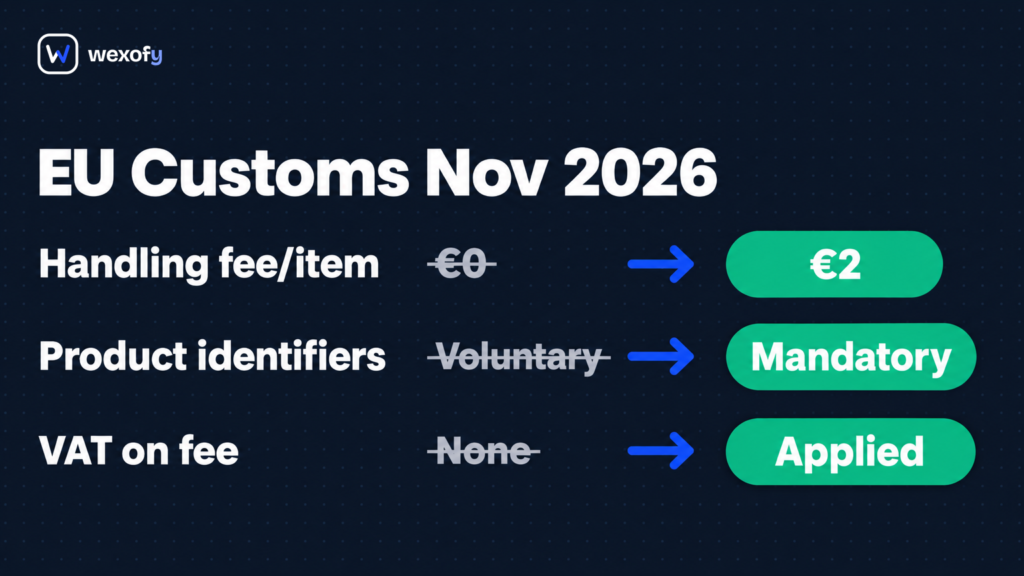
From 1 November 2026, every item shipped to an EU consumer from outside the EU carries a new EU customs handling fee of €2, on top of the €3 per-item duty that has been running since July. For a parcel with three different products sent to Germany, that is already €15 in customs charges before VAT is applied. If you run a WooCommerce store outside the EU and sell to European customers, you have eighteen days to decide how you will absorb or pass on this cost.
How the EU customs handling fee 2026 works
On 21 September 2026, the European Commission adopted delegated regulation C(2026) 6694, supplementing the new Union Customs Code (Regulation EU 2026/2108). The regulation sets the Union Handling Fee at €2 per item. The act is expected to be published in the EU Official Journal around 22 October; it applies from the tenth day after publication, which lands on 1 November 2026.
The fee sits on top of the €3 customs duty per item the EU introduced on 1 July 2026 for parcels declared at under €150. Both charges are calculated per customs “item,” a different unit from a physical product. In the regulation’s terms, an item is goods sharing the same HS (Harmonised System) subheading and country of origin within one consignment. Five identical T-shirts shipped together count as one item; a T-shirt and a watch count as two, regardless of how they are packaged.
The regulation also says VAT applies to the handling fee under Article 78 of EU VAT Directive 2006/112: the fee counts as an incidental expense in the taxable amount. The fee is also non-refundable, even when the customer returns the goods.
Also mandatory from 1 November: product identifiers on every customs declaration line. Each item must carry three codes: a Merchant Product Identifier (your SKU or listing ID), a Manufacturer Product Identifier (the supplier’s own product code), and a standardised identifier where one exists, such as a GTIN, EAN, UPC, or ISBN. These have been accepted voluntarily since 1 July; from 1 November they become mandatory, and missing or wrong identifiers can trigger delays or refused entry.
What this means for a WooCommerce store
The handling fee applies to all B2C distance sales imported into the EU. Order value does not limit it: a €250 order is charged the same €2 per item as a €40 order. The €3 duty applies only below the €150 threshold; above it, normal customs duty rates apply alongside the €2 fee.
Take a French order as an example: a customer buys a cotton T-shirt, a pair of jeans, and a belt, each under €50. Three different HS subheadings, so three items:
- Duty: €3 × 3 = €9
- Handling fee: €2 × 3 = €6
- Subtotal before VAT: €15
- French VAT (20%) then applies to the product value plus these charges
If the goods in that order are worth €120 combined, the customer’s total customs burden is €15 plus 20% VAT on the €135 total (€120 goods + €15 in charges), which adds another €27. That is €42 in taxes and charges on a €120 order, most of it from charges that did not exist twelve months ago. If the customer then returns the goods, the €15 in duty and handling fee is gone; only the VAT on the goods value may be reclaimed.
For stores using IOSS (Import One-Stop Shop) to collect VAT at checkout, the handling fee must now be included in the taxable amount. Stores collecting EU VAT through IOSS that have not adjusted their VAT base will build up a shortfall that customs authorities can audit. If you generate EU VAT invoices automatically on order completion, like Wexofy Invoices does, make sure your product prices or shipping costs already include the handling fee before the invoice is generated, so the totals are correct from the start.
Some member states run their own handling charges on top of the Union fee. France has suspended its own charge for now; Italy has pushed its local fee to 1 December. The EU-level €2 still applies from 1 November in both countries; only the domestic surcharge is delayed.
In practice, the carrier or customs broker collects the fee from the declarant (usually the seller or the platform) and invoices it back. You need to know who that declarant is in your shipping setup before November 1, or unexpected invoices will arrive after the fact.
What to do now
- Confirm you are in scope. The fee applies to non-EU origin shipments to EU consumers. If you ship from an EU fulfilment warehouse, even if your company is registered outside the EU, those shipments are not affected. If you dropship from a supplier in China, the US, or anywhere outside the EU, you are in scope.
- Verify HS codes for every product. The fee count depends on how many distinct HS subheadings an order contains. Wrong or missing HS codes mean wrong fee counts and potential customs holds.
- Add GTIN or EAN data to products that lack it. WooCommerce 11.2 introduced GTIN support and added GTIN matching to the CSV importer; use it to bulk-update your catalogue before the mandatory identifier deadline hits on the same date.
- Recalculate landed costs and update EU shipping zones. Whether you absorb the fee or pass it on, your WooCommerce shipping rates for EU destinations need to reflect the new floor cost. A flat-fee shipping zone that was profitable in October may not be in November.
- Clarify who pays the carrier’s invoice. Ask your carrier or broker explicitly: who is the named declarant, when do they invoice you, and does their system itemise the €2 per line? Surprises here affect your cash flow.
- Update IOSS VAT calculations. If you use IOSS, the handling fee is part of the taxable amount. Check that your VAT configuration includes it, so the VAT collected at checkout matches what you owe.
- Watch for the Official Journal publication around 22 October. The November 1 date is confirmed in the delegated act but takes effect ten days after OJEU publication. If publication slips past 22 October, the November 1 date shifts accordingly (though this looks unlikely at this stage).
Who is not affected
EU-based WooCommerce stores shipping to EU customers are not affected. The fee covers customs processing costs for goods imported from outside the EU. If all of your stock sits in an EU warehouse, the handling fee does not apply to your shipments.
B2B shipments using a standard customs import declaration rather than the H7 distance-sale simplified procedure may follow different rules. Most WooCommerce stores selling retail to EU consumers will fall under the distance-sale rules, but stores selling primarily to VAT-registered EU businesses should check their specific customs procedure with a freight forwarder.
Sources
- European Commission: C(2026) 6694, Delegated Regulation setting the Union handling fee
- European Commission: €3 customs duty for low-value parcels
- European Commission: EU Customs Reform overview
- VATUpdate: VAT is due on the EU’s €2 Union Handling Fee for e-commerce imports
- Dimweigh: The EU’s €2 Handling Fee Is Set, What the Regulation Actually Says
- Glopal: EU Customs Changes on 1st Nov 2026