Personal Agent Protocol: What WooCommerce Stores Need to Know
Meta and Sierra published the Personal Agent Protocol on October 6. Here's what it means for WooCommerce stores and what to prepare now.
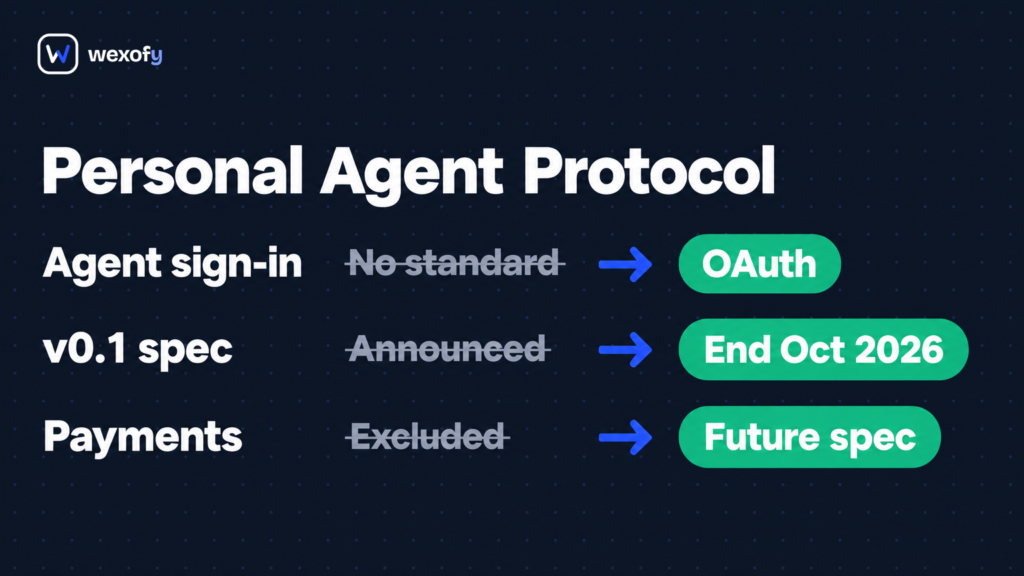
Meta and Sierra published the Personal Agent Protocol on October 6, 2026. The spec defines how AI shopping agents sign in to an online store, get scoped permission from the customer, and act on their behalf. WooCommerce isn’t a named launch partner, but the stores with complete product data and an API surface in place will be the first ones AI agents can use.
What the Personal Agent Protocol announced
Sierra co-founders Bret Taylor and Clay Bavor introduced the protocol at Sierra Summit on October 6, alongside a joint statement from Meta. The Sierra announcement frames it as infrastructure for a world where people delegate shopping to AI agents, and where businesses need a way to verify and control what those agents are allowed to do.
Authentication in v0.1 runs on OAuth, the same standard behind “Sign in with Google.” Customers grant either read-only or write access to their account. Businesses can accept agent connections through their existing website, through an API using MCP or OpenAPI, or by routing agents through their own company agent. A store that has never touched an API can still work with agents through its regular web pages.
Payments are deferred. Billing data and payment flows will arrive in a future version. The v0.1 spec is due later in October 2026, with design workshops and a reference implementation to follow.
Partners backing the protocol at launch include Shopify, Stripe, Walmart, Genesys, Instinct, and Rocket. OpenAI and Anthropic are not part of the agreement at this stage.
On September 20, 2026, Amazon blocked Meta’s Muse AI agent from Amazon.com, saying it had not identified itself while browsing. To a server-side firewall, a legitimate AI agent shopping for a customer looks identical to a scraper. PAP is the proposed fix: a standardised handshake so both sides know what they’re dealing with.
What the Personal Agent Protocol means for a WooCommerce store
Shopify is a named partner and WooCommerce isn’t, but the protocol is open for anyone to implement. The v0.1 spec isn’t even published yet, and WooCommerce already supports what the protocol describes as its primary API access path.
WooCommerce has had MCP server support since late 2025. Stores with MCP enabled can already let agents query products, check inventory, and read order data. PAP’s authentication layer will sit on top of that connection. Once the spec ships, adding PAP is a matter of implementing the OAuth handshake, not building a new API.
Most WooCommerce stores run Stripe, and Stripe is a named PAP partner. When PAP’s future versions add payment flows, Stripe-connected stores are likely to get support early. WooCommerce is one of Stripe’s main platform integrations, so any Stripe PAP payment work will almost certainly cover WooCommerce. No changes to your payment setup are needed now.
Product data quality is what matters right now. An AI agent shopping for a customer reads structured data: product title, full description, GTIN or EAN, variant names, stock status, price. It doesn’t fill gaps. If your products have missing GTINs, vague descriptions, or stale inventory numbers, an agent comparing your store with a competitor that has complete data will skip yours. Google Shopping already applies this pressure through its 2026 product spec updates. PAP extends the same logic to direct agent browsing.
None of the named partners are European businesses, and the spec makes no mention of GDPR. The OAuth-based permission grants PAP proposes interact directly with consent requirements: a customer granting an agent write access to their account is a consent event. Whether that satisfies the documentation requirements a cookie banner imposes is an open question. EU stores should hold off on any early PAP implementation until there’s clarity on that.
What to do this week
- Check your WooCommerce version. MCP support is available from 10.3 onward. If you’re still on an older version, updating also closes the security vulnerabilities fixed in 11.2, which shipped October 7.
- Audit your product data. Every product needs a GTIN (EAN, UPC, or ISBN where applicable), a description that answers specific questions, accurate stock levels, and correct pricing. Check for placeholder text and blank attribute fields. This pays off in Google Shopping now and in PAP readiness when the spec ships.
- Review your bot-blocking rules. If your security plugin or hosting firewall blocks unrecognised crawlers by default, you could inadvertently block PAP-compliant agents. Know what rules are active so you can whitelist legitimate PAP user agents once the v0.1 spec publishes their identifiers.
- Read the v0.1 spec when it drops. It’s due later this month. Watch developer.woocommerce.com for WooCommerce-specific guidance. If an official integration path is published, that’s where it will appear first.
- Don’t install anything claiming to be “PAP-ready.” The spec isn’t final, no authoritative WooCommerce extension exists, and the OAuth flow isn’t published. Any plugin claiming PAP support right now is speculative.
What PAP doesn’t cover yet
Payments are the obvious gap. Agents can browse, compare, and interact with accounts, but completing a purchase (transferring payment credentials, confirming a charge) is deferred. The ability to take orders through an AI agent is the practical goal for most store owners. It won’t be possible until a future version of the spec.
ChatGPT and Claude operate outside PAP for now. OpenAI and Anthropic not being named partners means the agents most consumers currently use won’t follow this standard until there’s broader adoption or a competing spec emerges. Watch whether they join, or whether Anthropic’s MCP and OpenAI’s emerging commerce work become a parallel track.
The v0.1 spec, due by end of October, is the document that matters for implementation. What’s been published so far is a design proposal. The specific headers, endpoints, token structures, and error handling that a WooCommerce plugin would need are all defined there. Until the spec ships, nothing in the announcement is implementation-ready.
Sources
- Sierra: Introducing Personal Agent Protocol
- PYMNTS: Meta and Sierra Build Standard for How Personal Agents Interact With Businesses
- Implicator: Meta and Sierra Draft a Sign-In Standard for AI Agents
- WooCommerce: Stripe’s Agentic Commerce Suite Launching with WooCommerce Support from Day One
- Search Engine Roundtable: Google Updates Some Merchant Center Product Specifications For 2026