WooCommerce Privilege Escalation CVE-2026-106608 Explained
A WooCommerce privilege escalation flaw (CVE-2026-106608, CVSS 7.2) was disclosed on 10 October. Shop Manager accounts on versions 9.8.0-11.1.2 can escalate to full admin. Update to 11.2.1.
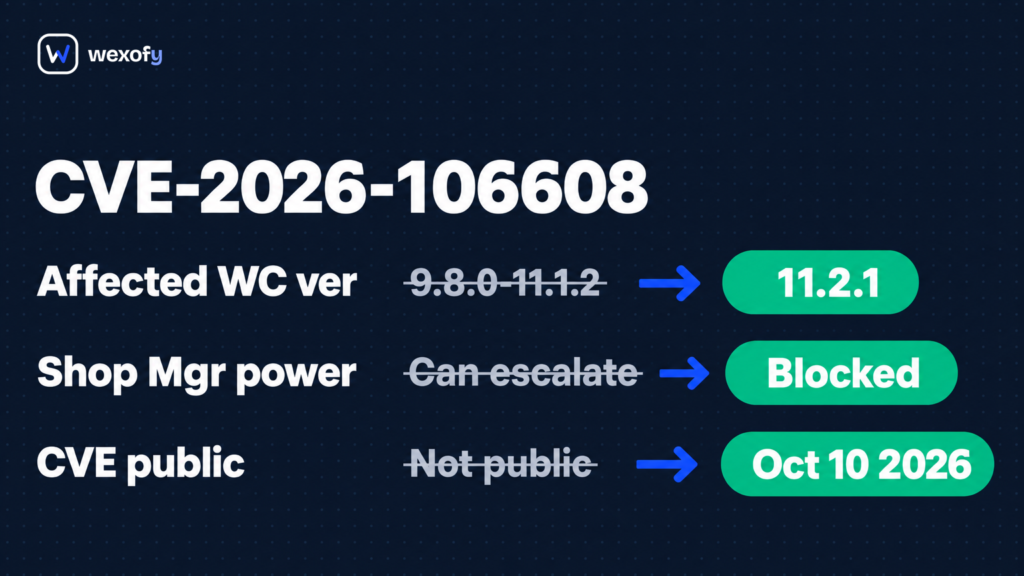
Patchstack publicly disclosed a WooCommerce privilege escalation vulnerability on 10 October 2026. Every store running WooCommerce 9.8.0 through 11.1.2 carries the flaw. The fix shipped three days earlier inside WooCommerce 11.2.1, so the window between patch and public disclosure is already closed for stores that have updated.
What the WooCommerce Privilege Escalation Vulnerability Does
CVE-2026-106608 is classified as an Incorrect Privilege Assignment flaw (CWE-266) with a CVSS 3.1 score of 7.2 (High). The vulnerability spans WooCommerce versions 9.8.0 through 11.1.2 (a range covering roughly three years of releases). Patchstack, which assigned the CVE, published the advisory on 10 October 2026.
WooCommerce fixed the underlying flaw in version 11.2.0 on 7 October 2026. The release notes describe what changed:
Security was hardened around shop managers editing other users. Shop managers can no longer modify users with additional elevated roles (such as bbPress or Ultimate Member roles).
Before version 11.2.0, a Shop Manager account on your site could be used to edit other users who held elevated roles granted by third-party plugins such as bbPress or Ultimate Member. By manipulating those accounts, an attacker who held Shop Manager credentials could escalate beyond the boundaries the Shop Manager role is supposed to enforce.
WooCommerce 11.2.1, released 9 October 2026, builds on 11.2.0. It adds two more fixes: a classic-checkout regression on stores that strip address fields, and postcode validation on the checkout block for Argentina and several other countries. Both the security fix and the checkout regression fix are in 11.2.1, so one update covers everything.
What This WooCommerce Vulnerability Means for Your Store
The CVSS attack vector is Network (AV:N) with Low complexity (AC:L). An attacker who already holds a valid Shop Manager session can run this exploit entirely over the internet, without needing local network access or any special setup.
The limiting factor is PR:H (High Privileges Required). The attacker must already hold a Shop Manager (or higher) account on your specific site. That means the risk comes from:
- Current or former employees, VAs, or contractors who have been given a Shop Manager login
- Any attacker who has obtained a Shop Manager credential through phishing, credential stuffing, or a brute-force attack against a weak password
- A compromised account sitting dormant since a previous data breach
For stores running membership or community plugins (bbPress for forum access, Ultimate Member for user profiles, BuddyPress for social features), the risk is concrete and direct. Those plugins attach additional capabilities and roles to user accounts, and it is exactly those elevated roles that a vulnerable WooCommerce installation lets a Shop Manager tamper with.
For stores without extra user-role plugins, the specific escalation path described in the 11.2.0 changelog is narrower. The underlying privilege assignment logic is still broken in versions before 11.2.0, and the fix is the same either way.
The reason a CVSS 7.2 flaw with a High privileges prerequisite still warrants prompt action is what follows a successful escalation. All three impact scores (Confidentiality, Integrity, Availability) are rated High. A WordPress Administrator can install plugins, modify theme code, pull a full copy of your customer and order database, and use your hosting account to pivot into other attacks. The PR:H gating keeps most opportunistic attackers out, but a targeted attack against a single Shop Manager account is not a complicated operation.
What to Do This Week
- Update to WooCommerce 11.2.1. Version 11.2.1 contains both the security patch for CVE-2026-106608 and the checkout regression fixes that caused some stores to hold off on the 11.2.x line. If your store was waiting for the checkout regression to be resolved before upgrading, that reason is now gone. Our post on WooCommerce 11.2 breaking changes covers what to test before updating, and what changed in 11.2.1 covers the regression fixes specifically.
- Audit your Shop Manager accounts. Go to Users → All Users and filter by the Shop Manager role. Remove the role from anyone who no longer needs it, and reset passwords for accounts that have not been used in recent months. If you see a Shop Manager account you do not recognise, treat it as a potential intrusion and change all admin credentials immediately.
- Review elevated plugin roles. If bbPress, Ultimate Member, BuddyPress, or any similar plugin is active on your site, check which users hold roles granted by those plugins. Look for recent, unexpected changes to those accounts. A privilege escalation attempt via this vulnerability shows up as a modification to one of those user records.
- Enable two-factor authentication on all privileged accounts. The PR:H vector means every additional barrier to obtaining a valid Shop Manager session directly reduces your exposure. A phished or credential-stuffed password stops being useful the moment 2FA is required. Most hosts and WordPress security plugins offer TOTP-based 2FA at no extra cost.
- Apply WooCommerce updates faster. WooCommerce 11.2.0 shipped the fix on 7 October; the CVE went public on 10 October. That three-day gap is normal for coordinated disclosure. Stores that defer minor WooCommerce updates by weeks routinely find themselves exposed after a CVE is published. A staging environment and a one-click rollback policy remove most of the reason to delay.
Who Is Not Affected
Stores already running WooCommerce 11.2.0 or 11.2.1 are protected (the fix landed in 11.2.0). Stores with no Shop Manager accounts at all, administrator-only setups, cannot be targeted via this specific escalation chain. Fresh installations starting from WooCommerce 11.2.0 or later have never been vulnerable.